



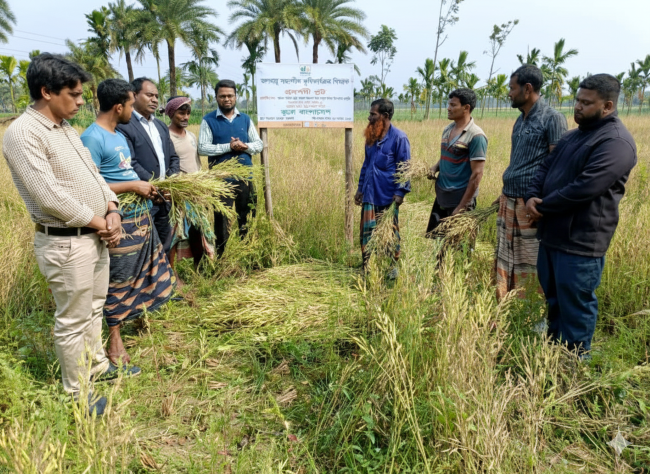
Just before harvesting his Aman paddy, Alal Uddin of Koidanga village did something unusual in his community:he broadcast mustard seeds (Bari-17) across his standing crop. No tilling. Noextra labor.
Ten days later, when the paddywas harvested, his field revealed a surprise—lively mustard seedlings thrivingbeneath the cut stalks. In just 85 days, he harvested 204 kilograms of mustardfrom one bigha (0.33 acres) of land, more than he had hoped.
Since Bari-17 is a short-durationvariety, Alal now grows three crops annually on land that previously yieldedonly two: Aman paddy, mustard, and maize.
𝗧𝗵𝗶𝘀 𝗶𝘀 𝗮 𝘀𝘁𝗼𝗿𝘆 𝗼𝗳 𝗹𝗼𝗰𝗮𝗹 𝗸𝗻𝗼𝘄𝗹𝗲𝗱𝗴𝗲 𝘂𝗻𝗶𝘁𝗶𝗻𝗴 𝘄𝗶𝘁𝗵 𝘀𝗺𝗮𝗿𝘁 𝘀𝘂𝗽𝗽𝗼𝗿𝘁—𝗮𝗻𝗱 𝗼𝗳 𝗮 𝗳𝗮𝗿𝗺𝗲𝗿 𝘄𝗵𝗼 𝗯𝗲𝗹𝗶𝗲𝘃𝗲𝗱 𝗰𝗵𝗮𝗻𝗴𝗲 𝗰𝗼𝘂𝗹𝗱 𝗯𝗲𝗴𝗶𝗻 𝗶𝗻 𝗵𝗶𝘀 𝗳𝗶𝗲𝗹𝗱.
Most Rajshahi farmerstraditionally grow just two crops yearly—Aman paddy, followed by either Bororice or maize. This system often leaves fields idle or demands excessiveirrigation for Boro rice, increasing costs while underutilizing land.
Now, farmers like Alal areadopting relay cropping with mustard, maximizing land productivity and profits.
BURO Bangladesh'sclimate-resilient agriculture initiative made this possible. The programtrained a local farmer group in relay cropping, conservation agriculture,improved variety selection, and optimal crop rotation. As a participant, Alalhosted a demonstration plot showcasing no-till mustard cultivation after Amanrice.
The relay method eliminated theneed for separate tillage for mustard. Rice stubble served as natural mulchafter pre-harvest seeding, retaining soil moisture, reducing irrigation needs,and recycling residual nutrients, avoiding additional fertilizer costs.
His total cost? 𝗕𝗗𝗧 𝟲,𝟳𝟰𝟬.
Revenue? 𝗕𝗗𝗧 𝟭𝟴,𝟯𝟲𝟬.
Net profit from land thatwould’ve stayed fallow? 𝗕𝗗𝗧 𝟭𝟭,𝟲𝟮𝟬.
In drought-prone Rajshahi, thehigh water demand of Boro rice is becoming unsustainable. As a result, BUROBangladesh promotes maize as a water-efficient alternative to Boro rice. WhileBoro requires 25–30 irrigations, maize needs just 4–5, significantly cuttingcosts.
Alal’s success has inspiredneighboring farmers to adopt the model—a low-input, high-return approachcreating new possibilities for smallholder farmers.
Through credit support,climate-appropriate crop recommendations, and technology demonstrations, BUROBangladesh is transforming agricultural practices across Bangladesh.